Introduction
You have a website.
It looks good. It explains what you do.
But the phone isn't ringing. And when you search for your own service on Google, your competitors show up first.
So someone tells you: "You need an SEO company."
Fair enough. But what does an SEO company actually do? And is it worth the money?
Here's the short answer:
An SEO company helps businesses rank higher on Google and other search engines, so they get more organic traffic, leads, and sales without paying for every click. It audits your website, researches keywords, fixes technical issues, creates content, builds backlinks, and reports on results.
That's the textbook version.
In this guide, I'll show you what that work looks like in real life. I'll cover the 9 core services, what happens each month, what it costs, how long it takes, and how to pick the right partner.
I'll also explain how an SEO company is different from an SEO specialist or an SEO consultant. (A lot of business owners mix these up.)
Let's get started.
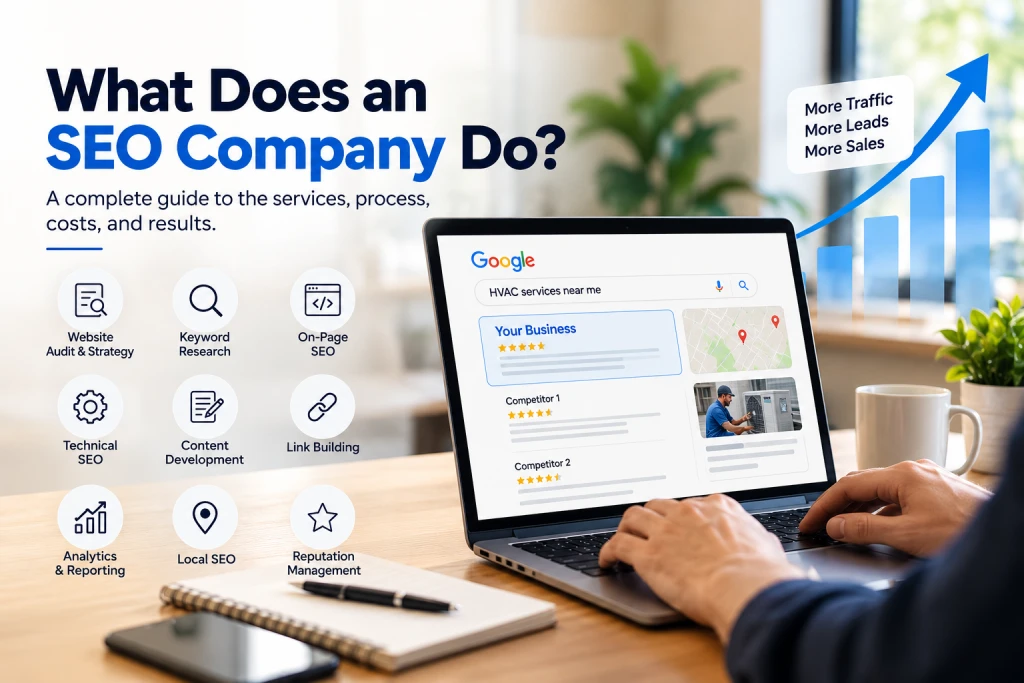
What Does an SEO Company Do? 9 Core Services
Most SEO companies split their work into the same core areas.
The mix changes from business to business. But a complete SEO program covers all nine of these.
1. Website Audit and SEO Strategy
Every SEO project starts with an audit.
The SEO company crawls your entire site, the same way Google does. It checks site structure, page speed, mobile-friendliness, crawl errors, and content gaps.
Then it looks at your competitors. Who ranks above you? For which keywords? And why?
The output is a roadmap: a prioritized list of fixes and opportunities, tied to your business goals (calls, leads, or sales).
In other words:
You stop guessing. You know exactly what's holding your site back, and what to fix first.
Pro tip: Not sure where you stand right now? Check your SEO visibility score to get a quick baseline.
2. Keyword Research
Keyword research means finding the exact words your customers type into Google.
But not all keywords are equal.
A good SEO company separates "buyer" searches from "research" searches .
For example, if you're a plumber:
- "emergency plumber near me" = someone with a flooded kitchen, ready to call now
- "why is my pipe leaking" = someone looking for information, maybe a DIY fix
Both are useful. But the first one makes you money today.
That's why SEO companies focus on high-intent and long-tail keywords. They bring in fewer searches, but far better leads.
3. On-Page SEO
On-page SEO is about optimizing each page so it matches what searchers want.
This includes:
- Title tags and meta descriptions
- Headings (H1, H2, H3)
- URL structure
- Internal links between related pages
- Images and alt text
The goal is simple. Each page should clearly answer one search intent.
Your "AC repair" page should be about AC repair. Not AC repair, installation, duct cleaning, and your company history all at once.
4. Technical SEO
Technical SEO fixes the issues you can't see, but Google can.
Things like:
- Slow page speed and poor Core Web Vitals
- Pages that break on mobile
- Missing or broken XML sitemaps
- Broken links and redirect chains
- Messy site architecture
- Missing schema markup (structured data)
Why does this matter?
Because even great content won't rank if Google can't crawl, read, and index it properly.
Think of technical SEO as the foundation of a house. Nobody admires the foundation. But without it, nothing else stands.
Further reading: Website optimization services
5. Content Development
Content is the fuel that SEO runs on.
An SEO company plans, writes, or updates:
- Service pages (one per service you sell)
- Location pages (one per area you serve)
- Blog posts that answer customer questions
- FAQ sections
The aim is to build topical authority . That means covering your subject so well that Google sees you as an expert in it.
Google also looks for E-E-A-T : experience, expertise, authoritativeness, and trustworthiness. Real author bios, real examples, and accurate information all help.
Further reading: Content marketing services
6. Off-Page SEO and Link Building
Backlinks are links from other websites to yours.
Google treats them like votes of confidence. A link from a trusted, relevant site tells Google: "This business is legit."
SEO companies earn links through:
- Digital PR and expert quotes
- Local directories and industry associations
- Partnerships and guest content
- Brand mentions that can be turned into links
They also monitor your link profile and disavow toxic links that could hurt you.
Note: Quality beats quantity. One link from a respected local news site is worth more than hundreds of links from spammy directories. If an agency offers "500 backlinks for $99", walk away.
7. Analytics and Reporting
A good SEO company tracks everything and tells you what it means.
That usually includes Google Analytics 4, Google Search Console, rank tracking, and call or form tracking.
But here's the thing:
Rankings and traffic are not the end goal. Leads and revenue are.
Your monthly report should answer one question clearly: "Is SEO bringing in more business?"
The SEO company then uses that data to adjust the strategy, especially after Google algorithm updates.
8. Local SEO
If you serve customers in a specific area, local SEO is often the fastest win.
It focuses on getting you into the Google Map Pack (the map with three businesses at the top of local searches).
The work includes:
- Optimizing your Google Business Profile
- Getting more (and better) reviews
- Building consistent citations (your name, address, and phone number across directories)
- Creating location pages for each area you serve
Local vs. national SEO: Local SEO helps you win your city or region. National SEO competes for broader keywords across the whole country, and usually needs much more content and authority.
Example: We help businesses in places like Kansas City and across Missouri show up when nearby customers search. See all the locations we serve .
9. AI Search Visibility (AI Overviews, ChatGPT, Perplexity)
Search is changing.
More people now get answers straight from Google's AI Overviews, ChatGPT, Gemini, and Perplexity, before they ever click a website.
So modern SEO companies also work on getting your business mentioned and cited in those AI answers.
Here's how:
- Answer engine optimization (AEO): Writing clear, direct answers that AI tools can pull and quote.
- Generative engine optimization (GEO): Building the brand signals, mentions, and structured content that AI models rely on.
- AI visibility tracking: Monitoring where and how AI platforms mention your brand.
The best part?
Most of this builds on strong traditional SEO. AI visibility doesn't replace SEO. It extends it.
Further reading: AEO services · GEO services · AI visibility services
What Is an SEO Company (or SEO Agency)
An SEO company is an outside team of specialists that improves your website's visibility in organic search results.
"Organic" means the unpaid listings. The ones below (and sometimes above) the ads.
Its job is to make sure Google can find your site, understand it, and trust it more than your competitors' sites.
You'll also hear the term SEO agency . Same thing. "SEO company" and "SEO agency" are used interchangeably. So if you've been wondering what an SEO agency does, everything in this guide applies.
Here's the simplest way to think about it:
- Paid ads are like renting traffic. The moment you stop paying, the traffic stops.
- SEO is like owning the property. It takes longer to build, but the traffic keeps coming without a cost per click.
Most SEO companies work with local service businesses, online stores, professional firms (lawyers, clinics, accountants), and B2B companies.
At Web and Ads Solutions , that's exactly who we work with every day.
Further reading: What is SEO (search engine optimization)?
Why Businesses Hire an SEO Company
Nobody hires an SEO company because they love SEO.
They hire one because something in the business isn't working.
Here are the five problems we hear most often:
- "Customers can't find us on Google." You rank on page 3 (or not at all) for the services you sell.
- "Our competitors outrank us." A rival with a worse service shows up first, and gets the call.
- "Our ad costs keep going up." Every lead costs more, and the moment you pause ads, leads dry up.
- "We don't have the time or the know-how." You're busy running the business. Learning SEO is a second job.
- "We get traffic, but no leads." Visitors land on the site and leave without calling or filling in a form.
Sound familiar?
A good SEO company fixes the root cause behind each of these. Not just the symptoms.
And the first step is usually the same: an audit to find out why you're not ranking.
Further reading: Why an SEO audit is important for your business
How SEO and Google Ads Work Together
A lot of business owners think it's SEO or Google Ads.
It's not. The two work best together.
Here's how a good agency connects them:
- Test keywords with ads first. Ads show which keywords actually turn into calls and sales within weeks. SEO can then target those proven keywords for the long term.
- Own more of the search results page. When you show up in both the ad slot and the organic results, you take up more space and push competitors down.
- Cut ad spend over time. Once you rank organically for an expensive keyword, you can reduce what you spend on ads for that term.
In other words:
Ads bring in leads now. SEO lowers your cost per lead later.
That's why we run both SEO and PPC management under one roof.
Further reading: The benefits of PPC advertising
What an SEO Company Does for Your Type of Business
SEO isn't one-size-fits-all.
What an SEO company focuses on depends on two things: what kind of business you run, and whether your website is new or established.
Local Service Businesses
Think plumbers, HVAC contractors, dentists, clinics, and law firms.
For these businesses, the priority is usually:
- Google Business Profile optimization and reviews
- A dedicated page for every service
- Location pages for every area you serve
- Call tracking, so you know which leads came from Google
The goal: show up in the Map Pack when someone nearby needs you right now .
Ecommerce Stores
For online stores, the focus shifts to product and category pages.
That means:
- Optimizing category pages for broad buyer keywords ("women's running shoes")
- Writing unique product descriptions (not copied from the manufacturer)
- Fixing duplicate content from filters and product variations
- Adding product schema so prices and reviews show in search results
- Making the site load fast, especially on mobile
New Websites
If your site is brand new, you have an advantage: you can build SEO in from day one.
A good SEO company will map keywords to pages before design starts. That way, your site structure, URLs, and content are set up to rank from launch.
This is much cheaper than fixing a site after it's built.
Further reading: Web development services · Website look and feel
Established Businesses With an Existing Site
If your site has been around for years, the work usually starts with cleanup:
- Audit and fix technical issues
- Refresh pages that used to rank but have slipped
- Merge or remove thin, outdated content
- Recover rankings lost after a site redesign or a Google update
Older sites often have hidden value. A few fixes can unlock rankings you've been close to for years.
What Working With an SEO Company Looks Like, Month by Month
This is the part most guides skip.
They list services. But they never tell you what actually happens after you sign.
So here's a realistic timeline:
|
Phase |
What the SEO company does |
What you'll see |
|---|---|---|
|
Month 1 |
Onboarding, full audit, keyword research, strategy, tracking setup |
A clear roadmap and a baseline report |
|
Months 2–3 |
Technical fixes, on-page optimization, Google Business Profile, first new content |
A healthier site and early ranking movement |
|
Months 4–6 |
Ongoing content, link building, local citations, fine-tuning |
Rankings and traffic start to climb |
|
Months 6–12 |
Scaling what works, new pages, conversion improvements |
A steady flow of leads from organic search |
What do you need to do?
Not much. But a few things really help:
- Give access to your website, Google Analytics, and Search Console
- Approve content and changes quickly
- Share what makes your business different (your real expertise is gold for content)
- Ask happy customers for reviews
Pro tip: Ask any agency to show you a sample monthly report before you sign. If they can't clearly show what work they did and what it achieved, that's a warning sign.
How Long Does SEO Take to Work?
Short answer: meaningful results typically take 6 to 12 months .
You'll often see early movement in months 3 to 6. Rankings start shifting, and some long-tail keywords begin bringing in traffic.
But SEO compounds. The work you do in month 2 keeps paying off in month 12 and beyond.
How fast it works depends on:
- Competition: Ranking for "lawyer" in a big city takes longer than "roof repair" in a small town.
- Your starting point: An older site with some authority moves faster than a brand-new domain.
- Budget and consistency: More content and links, published steadily, means faster results.
Note: Be careful with anyone who promises page one in 30 days. Real SEO doesn't work that way, and shortcuts can get your site penalized.
How Much Does an SEO Company Cost?
In the U.S., SEO agencies commonly charge $50 to $150 per hour , or $2,000 to $10,000+ per month , depending on scope. [Editor: confirm these ranges against a current pricing survey and link the source.]
That's a wide range. So let's break down how agencies charge:
|
Pricing model |
How it works |
Pros |
Cons |
|---|---|---|---|
|
Monthly retainer |
A fixed fee for ongoing work |
Consistent effort, predictable cost |
Needs a clear list of monthly deliverables |
|
Hourly |
You pay for time spent |
Flexible for small tasks |
Hard to budget, no long-term plan |
|
Project-based |
One price for one project (an audit, a migration) |
Clear scope and cost |
Stops when the project ends |
|
Performance-based |
You pay for rankings or leads |
Feels low-risk |
Often encourages shortcuts and vanity keywords |
What drives the price up or down?
- How competitive your industry is
- How many locations you serve
- How much content you need each month
- How much technical work your site needs
Cheap vs. quality SEO:
A very low monthly fee usually means automated reports, generic content, and low-quality links. It can do more harm than good.
A quality agency costs more, but you get real strategy, original content, and links that last.
Further reading: Compare our SEO packages , from the SEO Signature Plan to the SEO Premium Plan . Want faster growth? See the SEO plan with Velocity or the plan without Velocity .
Is Hiring an SEO Company Worth It?
It depends on one thing: what a new customer is worth to you.
Here's a simple way to check:
Extra leads per month × close rate × average customer value = monthly return
Let's run an example.
Say you're an HVAC company. SEO brings in 20 extra leads a month. You close 30% of them. Each job is worth $1,500 on average.
20 × 0.30 × $1,500 = $9,000 per month in new revenue.
If your SEO fee is $2,500 a month, that's a strong return. And unlike ads, those leads don't stop when you pause spending.
(These numbers are for illustration only. Plug in your own.)
When it's NOT worth it yet:
- You've just launched and have almost no budget
- You can't handle more customers right now
- Your website itself needs a rebuild first
In those cases, start small. Set up your Google Business Profile, ask for reviews, and get the basics right. Then bring in an SEO company when you're ready to grow.
SEO Company vs. SEO Specialist vs. SEO Consultant
These three terms get mixed up all the time.
They all "do SEO". But the way they work, and what you get, is very different.
What Does an SEO Specialist Do?
An SEO specialist is a hands-on practitioner. Usually one person, either on your team or working freelance.
Day to day, an SEO specialist:
- Researches keywords
- Updates titles, meta descriptions, and on-page content
- Fixes technical issues flagged in audits
- Tracks rankings and traffic
- Reports results to a manager or client
Many specialists focus on one area, like technical SEO, content SEO, or local SEO.
Best for: Businesses that already have a marketing team and want SEO handled in-house.
What Do SEO Consultants Do?
An SEO consultant is a strategic advisor.
They audit your site, diagnose problems, build the strategy, and often train your team. But they usually don't do all the hands-on work themselves.
You'll typically hire a consultant for:
- A one-off audit or strategy
- A site migration or redesign
- Recovering from a Google penalty or traffic drop
- A second opinion on your current SEO
Best for: Businesses that have people to implement the advice, or that have one specific problem to solve.
Which One Do You Need?
Here's a quick comparison:
|
|
SEO company / agency |
SEO specialist |
SEO consultant |
DIY |
|---|---|---|---|---|
|
Who does the work |
A full team |
One person |
Mostly advises; your team executes |
You |
|
Skills covered |
All services |
Usually one or two areas |
Strategy-led |
Limited |
|
Tools |
Premium tools included |
Varies |
Usually included |
You pay for them |
|
Time needed from you |
Low |
Medium (you manage them) |
Medium to high |
Very high |
|
Best for |
Businesses that want it handled end to end |
Companies with an in-house marketing team |
Teams that can implement |
Very small budgets |
For most small and mid-size businesses, an SEO company is the simplest option. You get a whole team of specialists for less than the cost of one full-time hire.
Further reading: Get to know our team , or see all our services .
How to Choose the Right SEO Company
Not all SEO companies are equal.
Some are excellent. Some will take your money and send you a PDF every month.
Here's how to tell the difference.
Questions to Ask Before You Hire
- "What exactly will you do each month?" You want specific tasks, not "ongoing optimization."
- "How do you report results, and which metrics do you track?" Look for leads and revenue, not just rankings.
- "Can I see results from businesses like mine?" Case studies in your industry are a big plus.
- "Who owns the content and accounts if we stop working together?" The answer should be: you.
- "How long is the contract, and what's the notice period?" Long lock-ins with no exit are a bad sign.
Red Flags to Watch For
Walk away if you hear any of these:
- "We guarantee #1 rankings." Nobody controls Google. Not even Google's own partners.
- "We use secret methods." Good SEO is transparent. There's nothing to hide.
- Reports with no record of the work done. Charts are nice. But what did they actually do ?
- Cheap bulk link packages. These can get your site penalized.
- They own your Google Business Profile or Analytics. Your accounts should always belong to you.
Pro tip: Start with a paid audit or a short trial period. It's the easiest way to see how an agency thinks and communicates before committing long-term.
Case Study: How SEO Helped a [Industry] Business
[Editor: replace every bracket with a real, anonymized client result. Do not publish invented numbers.]
Here's what this looks like in practice.
The business: A [type of business] in [city/region].
The problem: They were stuck on page [X] for their main service keywords. Almost all of their leads came from paid ads.
What we did:
- Ran a full audit and fixed [number] technical issues
- Rebuilt [number] service and location pages around buyer keywords
- Optimized their Google Business Profile and started a review campaign
- Earned links from [type of sites, e.g. local news and industry associations]
The results after [X] months:
- Organic traffic: up [X]%
- Leads from organic search: [X] per month (up from [X])
- Keywords on page one: [X]
[Optional: add a short client quote and a Search Console screenshot.]
FAQs
What does an SEO agency do differently from a digital marketing agency?
An SEO agency focuses on organic search: rankings, traffic, and leads from Google and AI search. A digital marketing agency covers a wider mix, such as ads, social media, email, and design. Some agencies, like ours, offer both. Learn more in our digital marketing guide .
What does an SEO specialist do day to day?
An SEO specialist researches keywords, updates on-page content and meta tags, fixes technical issues, tracks rankings, and reports on results. Most specialists focus on one or two areas of SEO.
What do SEO consultants charge?
Consultants usually charge by the hour or by the project, such as a one-off audit or strategy. Rates vary widely by experience and location. Always ask for a fixed quote and a clear list of deliverables.
Do SEO companies guarantee rankings?
No reputable SEO company guarantees #1 rankings. Nobody controls Google's algorithm. What a good agency can promise is clear work, honest reporting, and a proven process.
How do I know if my SEO company is doing a good job?
Look at business results, not just rankings. Are organic leads and sales growing? Does the monthly report show the specific work done? Can they explain what's working and what's next?
Can an SEO company help recover from a Google penalty?
Yes. Recovery usually involves a backlink audit to remove or disavow toxic links, a technical audit, and a content quality review. For manual penalties, the agency then files a reconsideration request with Google.
Should content be written by the agency or in-house?
Either works. Many agencies write the content for you. Others provide detailed briefs (topics, structure, keywords) so your in-house team can write it. Your team's first-hand expertise makes content stronger either way.
Does SEO still matter with AI search?
Yes. AI tools like Google's AI Overviews and ChatGPT often draw on well-ranked, trusted websites. Strong SEO is the foundation for showing up in AI answers too.
Do I need SEO if I'm already running Google Ads?
It's a smart move. Ads bring leads now, while SEO builds traffic you don't pay for per click. Together, they lower your overall cost per lead over time.
Ready to Get Found on Google?
So, what does an SEO company do?
It makes sure the people searching for what you sell find you , not your competitors.
That means auditing your site, targeting the right keywords, fixing what's broken, publishing content that answers real questions, earning trust from other websites, and proving it all with clear reports.
It's not instant. But done right, it becomes your most reliable source of leads.
Want to see where your site stands right now?
Book a free SEO strategy call and we'll show you exactly what's holding your rankings back, and what to fix first.
Prefer to talk first? Contact our team .
Further reading: More guides on the Web and Ads Solutions blog